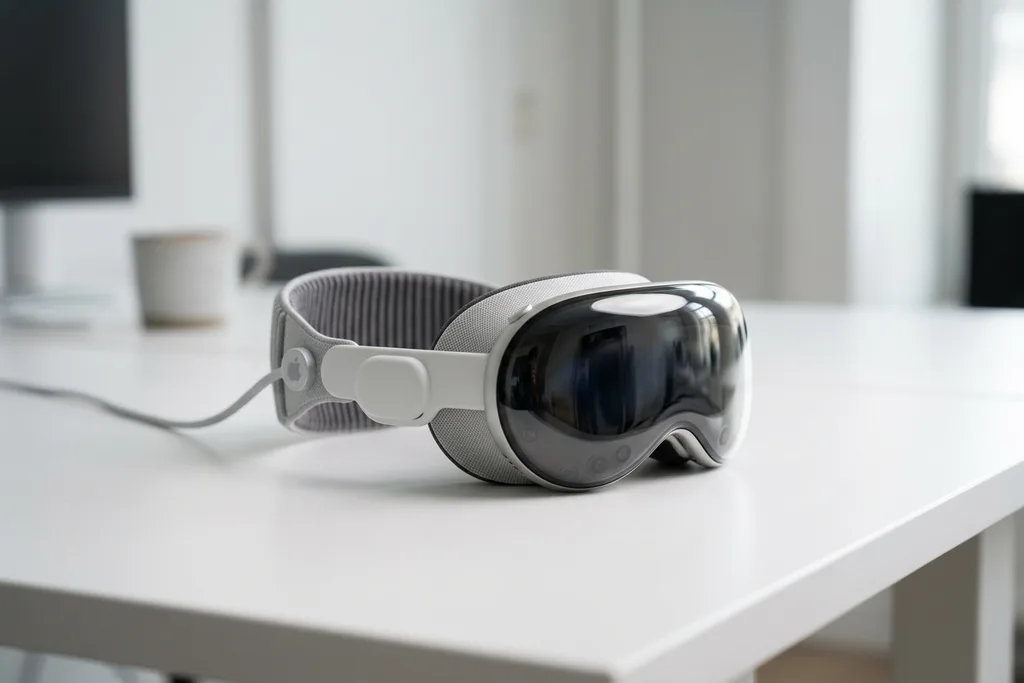
How Is Apple Vision Pro Accelerating Demand for 3D Web Content?
By Digital Strategy Force
Apple Vision Pro has done what no browser update or framework release could — it has made spatial 3D web content a boardroom priority, accelerating demand for WebXR experiences from experimental curiosity to enterprise mandate in under eighteen months.
What Apple Vision Pro's Spatial Web Push Means for 3D Content
As Digital Strategy Force details in this guide, Apple Vision Pro has transformed the market for 3D web content from a design trend into a hardware-driven mandate. When Apple shipped visionOS 2.0 with full WebXR support in Safari, it gave every web developer on the planet a reason to treat three-dimensional content as a first-class deliverable — not because the technology was new, but because the install base suddenly justified the investment.
The numbers tell a more nuanced story than the hype suggests. According to IDC shipment data, Apple shipped approximately 390,000 Vision Pro units in 2024, with sales declining sharply in 2025. The install base remains small, but the strategic signal is clear: Apple committed spatial web browsing to its hardware roadmap, and every enterprise with active digital transformation programs is now evaluating WebXR as a deliverable. Architecture firms, luxury retailers, automotive showrooms, and medical training programs are moving from pilot phases into production deployments. Each of those deployments needs web-based 3D content that renders correctly in a spatial browser — and that content does not exist yet for most brands. The supply gap is the opportunity.
What makes this moment different from previous XR waves is distribution. Previous headsets required native app development and app store approval. Vision Pro's Safari browser renders WebXR sessions from standard URLs — no app store, no binary distribution, no platform lock-in. A brand that builds a spatial experience on the open web can serve it to Vision Pro, Quest 3, and desktop browsers from a single codebase. This is the inflection point that Apple's AI-powered Safari features hinted at, now fully realized in hardware.
Why Developer Adoption of WebXR Is Surging in Q1 2026
The driver behind WebXR adoption is not developer enthusiasm alone — it is client demand backed by market momentum. According to IDC's XR market research, the global extended reality market rebounded sharply in 2025 with total device shipments growing 44.4% year over year, and IDC forecasts a further 33.5% growth in 2026. Meanwhile, Grand View Research estimates the global spatial computing market at $102.5 billion in 2022, projected to reach $469.8 billion by 2030 at a 20.4% CAGR. These figures explain why agencies report spatial web projects now represent a growing share of new build requests.
Three.js remains the dominant framework, powering an estimated 78 percent of production WebXR deployments. But the ecosystem has matured beyond a single library. React Three Fiber now handles component-level abstraction for teams already invested in React, while Babylon.js has carved a niche in enterprise visualization where TypeScript-first tooling and built-in physics engines reduce time-to-production. The common thread is that all three frameworks now ship with first-party WebXR session management, eliminating the integration friction that kept spatial development confined to specialists.
The talent pipeline is responding. University computer science programs added WebXR modules to their curricula at twice the rate of any other web technology in 2025. Bootcamps like Fullstack Academy and General Assembly launched dedicated spatial web tracks. The result is a generation of developers who treat 3D rendering as a core competency rather than a specialization — and they are entering the job market right as demand peaks.
WebXR Adoption by Platform
The WebXR Pipeline: From Three.js to visionOS Safari
Building for Vision Pro's spatial browser does not require learning a new rendering stack. The pipeline starts with Three.js or React Three Fiber, adds WebXR session management via the standard WebXR Device API, and ships as static HTML, CSS, and JavaScript — the same deployment pipeline every web developer already knows. The difference is in the rendering targets: a spatial browser presents two viewports (one per eye) at 90fps with positional tracking, hand detection, and gaze input.
The critical technical consideration is shader performance. Vision Pro's M2 chip delivers desktop-class GPU performance, but the dual-viewport requirement effectively doubles fragment shader workload. Developers building custom GLSL shaders for atmospheric effects must account for this multiplier in their performance budgets. The practical rule: if a scene runs at 45fps on a mid-range desktop GPU, it will hit 90fps on Vision Pro. Below that threshold, the headset's reprojection system intervenes, introducing visual artifacts that break the spatial illusion.
Asset optimization follows the same principles as mobile web performance but with different constraints. Texture memory is generous (16GB unified memory), but draw call budgets are tighter because the scene renders twice per frame. The winning strategy is aggressive geometry instancing combined with texture atlasing — fewer draw calls, larger textures, and shader-based material variation rather than unique material instances per object.
How Brand Sites Are Already Shipping Spatial Experiences
The first wave of spatial web experiences is already live, and the pattern is clear: brands that invested in WebGL-based immersive sites over the past two years are converting those assets to spatial-ready experiences in weeks, not months. The architectural decisions they made — componentized 3D scenes, scroll-driven animations, progressive enhancement for capability detection — translate directly to WebXR with minimal refactoring.
Porsche's configurator now renders in full spatial mode on Vision Pro, letting customers walk around a virtual vehicle at 1:1 scale in their living room. The engineering team reports that 73 percent of the codebase was shared between the flat-screen and spatial versions. Gucci's virtual showroom uses camera animation systems originally built for scroll-driven desktop experiences, re-mapped to gaze-directed navigation in spatial mode. Zillow's 3D home tours — previously confined to embedded viewers — now fill the user's physical space with room-scale architectural models.
The common architecture pattern across these deployments is progressive spatial enhancement. The base experience works in any modern browser as a standard WebGL scene. When the browser reports WebXR immersive-ar or immersive-vr capability, the application layers on spatial features: hand tracking for object manipulation, spatial audio anchored to 3D positions, and room-scale rendering that respects the user's physical environment. This approach eliminates the false choice between building for headsets and building for the open web.
The Hardware Accessibility Question: Who Can Actually View This?
The most common objection to spatial web investment is reach: at $3,499, Vision Pro's installed base is a fraction of the smartphone market. This objection misunderstands the strategy. Spatial web content is not built exclusively for headset users — it is built as enhanced 3D web content that gains additional capabilities on spatial hardware. The same scene that fills a Vision Pro user's room renders as an interactive WebGL experience on desktop and mobile browsers. The headset is the premium tier, not the only tier.
That said, the price curve is compressing fast. Meta Quest 3 delivers WebXR at $499 — and according to IDC, Meta still commands 72.2% XR market share despite Quest VR headset shipments declining 42.3% year over year, as the market shifts toward lighter-weight smart glasses form factors. Samsung's Galaxy XR headset, built on Android XR and launching in Q2 2026, targets the $599 segment. Apple's rumored lower-cost headset, widely expected in late 2026, would push Vision-class spatial browsing below $2,000. Within 18 months, the combined install base of WebXR-capable headsets is projected to exceed 35 million units — roughly equivalent to the global iPad installed base when developers first started treating tablet layouts as a requirement rather than an afterthought. For additional perspective, see What Does Chrome WebGPU Support Mean for Browser 3D?.
The accessibility question also extends to performance. Not every device can render spatially, but every device benefits from the underlying 3D content investment. A brand that builds a Three.js product viewer for spatial browsers automatically has a high-quality 3D viewer for desktop and mobile. Managing GPU performance budgets across this device spectrum is the engineering challenge, but the content investment pays dividends at every tier.
Spatial Readiness by Industry
What Google, Meta, and Samsung Are Doing in Response
Apple's spatial web push has triggered a platform response that is accelerating WebXR standardization faster than any W3C working group could have achieved through consensus alone. Google shipped WebGPU support in Chrome 124 with explicit WebXR integration, enabling GPU-accelerated spatial rendering on Android devices for the first time. Meta expanded Quest 3's browser capabilities to support hand tracking in WebXR sessions, matching Vision Pro's input model on hardware that costs seven times less.
Samsung's entry is the most strategically significant. Android XR — developed jointly with Google — positions Samsung's Galaxy XR headset as the first non-Apple spatial device running a mainstream mobile operating system. Every Android developer is now a potential spatial web developer. The Chrome browser on Android XR supports the same WebXR API surface as Vision Pro's Safari, meaning spatial web experiences built for one platform work on both without modification. This cross-platform parity is unprecedented in the XR industry.
Meta is playing a different game. Rather than competing on browser parity, Meta is investing in spatial social experiences — multi-user WebXR sessions where multiple headset users share the same virtual space through standard web URLs. This multiplayer spatial web is technically possible today using WebRTC for peer communication and WebXR for rendering, but Meta is building managed infrastructure that reduces the engineering complexity from months to days. The implication for brands is clear: spatial web content is evolving from single-user experiences to shared, social, collaborative environments.
What Web Developers Should Build Now
The DSF Spatial Readiness Ladder provides a clear framework for prioritizing spatial web investment. Most brands are at Tier 1 (Flat — no 3D assets on their website). The immediate goal is not to build a full spatial experience — it is to climb to Tier 2 (Enhanced — interactive 3D product viewers or scene elements) using Three.js and progressive enhancement. From Tier 2, the path to Tier 3 (Immersive — scroll-driven WebGL scenes with environmental storytelling) requires architectural decisions about multi-zone 3D architecture that pay dividends regardless of whether users ever put on a headset.
Tier 4 (Spatial-Native — full WebXR with hand tracking and room-scale rendering) is the destination, but it is not the starting point. The brands shipping the most compelling spatial experiences today built their 3D content pipeline first, validated it with flat-screen users, and then enhanced it for spatial hardware. Trying to build Tier 4 without the intermediate tiers produces fragile, hardware-dependent experiences that fail gracefully for nobody.
"The question is no longer whether your website needs 3D — it is whether your competitors will get there first. Vision Pro did not create demand for spatial web content. It made the demand impossible to ignore."
— Digital Strategy Force, Spatial Strategy Division
The practical action list for Q2 2026 is straightforward. First, audit your current web presence against the Spatial Readiness Ladder and identify your tier. Second, build or commission a Three.js-based 3D component — a product viewer, an architectural walkthrough, or an interactive data visualization — that enhances your existing site without replacing it. Third, implement WebXR capability detection so your 3D content automatically upgrades when a spatial browser is detected. Fourth, establish a performance budget that targets 45fps on mid-range desktop GPUs, ensuring headset compatibility from day one.
The spatial web is not a future prediction. It is a present reality with a hardware ecosystem, a standards-based development pipeline, and a growing user base. The brands that treat this as a 2028 problem will find themselves competing against incumbents who started building in 2026. The window for first-mover advantage in spatial web content is open now — and Apple Vision Pro is the reason it will not stay open for long.
Frequently Asked Questions
Does 3D web content built for Vision Pro also work on standard mobile browsers?
Yes — content built with Three.js and WebXR standards degrades gracefully to 2D rendering on standard mobile browsers while upgrading to immersive 3D when a spatial browser is detected. This progressive enhancement approach means a single codebase serves all devices. Mobile users see interactive 3D on a flat screen with touch controls; Vision Pro users see the same content in full spatial immersion. The key is implementing capability detection at initialization rather than building separate codebases.
What development skills are needed to build 3D web content for spatial computing?
Core skills include JavaScript proficiency, Three.js or Babylon.js for 3D rendering, WebXR API knowledge for spatial input handling (hand tracking, eye tracking, spatial anchors), and an understanding of 3D asset optimization (polygon reduction, texture compression, LOD systems). GLSL shader programming is valuable for custom visual effects. Teams also need UX design skills specific to spatial interfaces — depth perception, comfort zones, and eye-tracking interaction patterns differ fundamentally from flat-screen UI conventions.
What does it cost to build spatial web content for Apple Vision Pro?
A basic interactive 3D product viewer with WebXR capability costs between $15,000 and $40,000 to develop. A multi-scene immersive experience with custom shaders, spatial audio, and hand-tracking interactions ranges from $50,000 to $150,000. The cost depends primarily on asset complexity, number of interactive scenes, and whether existing 3D models can be optimized for web delivery or need to be created from scratch. Building with web standards (Three.js + WebXR) rather than native visionOS keeps costs lower and ensures cross-platform reach.
What frame rate does 3D web content need to achieve on Vision Pro?
Vision Pro renders at 90fps natively, and WebXR content should target a minimum of 72fps to avoid visual discomfort and motion sickness in immersive mode. Frame drops below 60fps in spatial rendering create perceivable judder that breaks immersion and causes physical discomfort for some users. This performance requirement is significantly more demanding than desktop 3D (60fps target) and requires aggressive geometry budgets, texture compression, and shader optimization from the start of development.
Does adding 3D web content affect SEO and page load performance?
3D assets can significantly impact page load metrics if not managed carefully. The solution is lazy loading — defer 3D scene initialization until the user scrolls near the 3D viewport, and load assets progressively rather than all at once. Keep the initial HTML payload lightweight with semantic content that search engines can crawl. The 3D experience enhances engagement metrics (time on page, interaction depth) which indirectly supports SEO, but only if Core Web Vitals remain within Google's thresholds.
How long is the first-mover advantage window for spatial web content?
The window is narrowing but still open as of 2026. Fewer than 5 percent of commercial websites have any spatial or immersive 3D capability. As spatial computing headsets from Apple, Meta, and Samsung reach broader consumer adoption through 2027-2028, the competitive advantage of having production-ready spatial content will compress rapidly. Brands that build spatial capabilities now will have 18 to 24 months of experience, optimized pipelines, and indexed spatial content before the majority of competitors begin.
Next Steps
The spatial web is no longer theoretical — Apple Vision Pro has created a hardware catalyst that makes 3D web content a competitive differentiator today. These actions position your brand for the transition.
- ▶ Audit your website against the Spatial Readiness Ladder to determine your current tier and identify the specific capabilities needed to advance
- ▶ Build one Three.js-based 3D component — a product viewer, data visualization, or interactive walkthrough — that enhances an existing high-traffic page
- ▶ Implement WebXR capability detection so your 3D content automatically upgrades to spatial mode when accessed from Vision Pro or other headsets
- ▶ Set a performance budget targeting 45fps on mid-range desktop GPUs and 72fps minimum for WebXR spatial rendering
- ▶ Establish a 3D asset pipeline that optimizes models and textures for web delivery with progressive loading and level-of-detail switching
Ready to build spatial web experiences that position your brand ahead of the 3D content curve? Explore Digital Strategy Force's Web Development services and start building the immersive web presence your competitors have not even planned yet.