How Knowledge Graphs Power AI Search Results
By Digital Strategy Force
Every AI-generated answer is shaped by a decision made before your query arrives — a decision about which entities and relationships are real, authoritative, and worth citing. Knowledge graphs are the infrastructure that records those decisions, and this guide explains exactly how they work.
From Keywords to Entities: The Structural Shift in AI Search
Every answer a large language model generates is downstream of a decision made long before the query arrives — a decision about which entities, concepts, and relationships are real, authoritative, and worth citing. Knowledge graphs are the infrastructure that records those decisions, and Digital Strategy Force built this guide to show exactly how that infrastructure shapes what AI systems say about your brand.
The shift from keyword-based search to entity-based retrieval did not happen overnight, but its implications are now impossible to ignore. When Google introduced its Knowledge Graph in 2012 with a landmark blog post titled "things, not strings," it telegraphed the direction the entire industry would follow. AI search systems today — from Gemini to Perplexity to ChatGPT's web retrieval mode — do not scan for matching phrases. They resolve queries against a structured understanding of the world where people, organizations, concepts, and places exist as nodes in a network of verified relationships.
For businesses and content creators, this distinction is not semantic. A brand that ranks highly for keyword matches but lacks a coherent entity profile in the underlying knowledge graph can be entirely absent from AI-generated answers. The channel is different, the retrieval logic is different, and the optimization strategy must be different too. Understanding how knowledge graphs work is the prerequisite for every other AI search tactic.
Those numbers describe a landscape where the volume of structured, machine-readable fact is measured in billions of items, and the proportion of the web actively contributing to that graph via structured data markup is still surprisingly low. That gap between scale and participation is where competitive advantage lives right now.
Anatomy of a Knowledge Graph
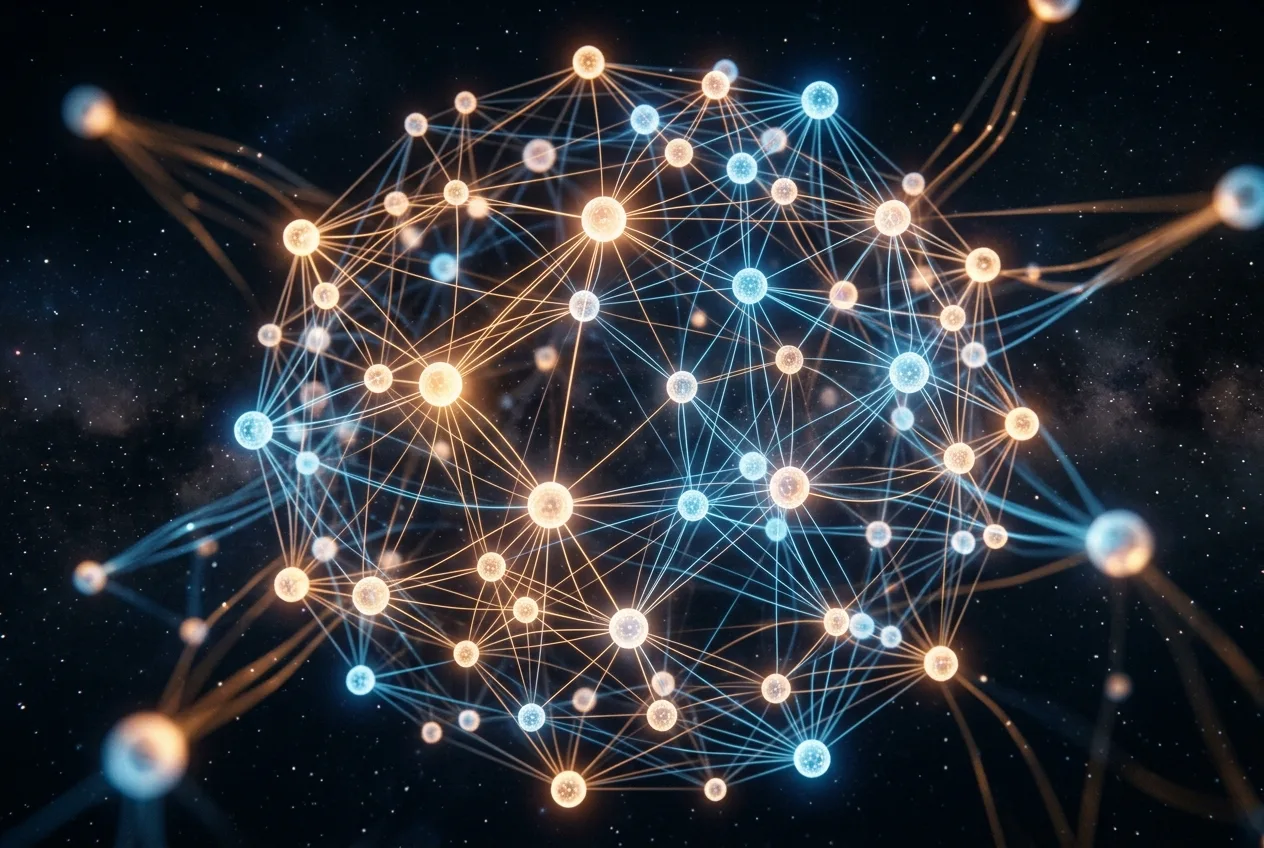
A knowledge graph is a directed property graph that models real-world entities as nodes and the relationships between them as labeled edges. Each node represents a distinct thing — a company, a person, a concept, a location — and each edge asserts a specific relationship between two nodes. The graph accumulates facts through systematic ingestion of structured sources (Wikipedia, Wikidata, official filings), semi-structured sources (news articles, web pages with schema markup), and unstructured sources processed via natural language extraction.
What makes a knowledge graph different from a standard database is the combination of semantic richness and traversal capability. A traditional database can tell you that Company A exists. A knowledge graph can tell you that Company A was founded in a specific city, employs people with expertise in a set of disciplines, has products that solve a class of problems, and is cited by publications that cover a defined industry — and it can traverse all those connections simultaneously to answer composite queries.
Google's Knowledge Graph, which powers the information panels you see on search results pages, had amassed over 500 billion facts about 5 billion entities by May 2020 — growing from just 570 million entities and 18 billion facts when it launched in 2012. The open-source Wikidata graph now holds over 121 million items with more than 2.4 billion individual edits, forming one of the primary training and grounding sources for AI language models.
The HTTP Archive's Web Almanac structured data chapter found that roughly 44% of the top pages in its dataset deployed some form of structured data markup — meaning more than half of the measurable web is contributing nothing to the machine-readable layer that knowledge graphs depend on. For any brand willing to invest in this infrastructure, the competitive field is remarkably open.
The Triple-Store Model Explained
Every fact inside a knowledge graph is encoded as a triple: a subject, a predicate, and an object. This standardized representation — called RDF (Resource Description Framework) — is what allows graphs from different sources to be merged and queried uniformly. Understanding triples is the foundation for understanding why structured data markup matters so much to AI search visibility.
This chain of triples is not just a data structure — it is a pathway through the graph. When an AI model processes the query "who can help with AI search visibility," it traverses exactly this kind of chain, moving from the concept of AI search visibility through the organizations connected to it, weighted by the confidence scores attached to each edge. Brands with well-formed, corroborated triples appear at the end of that traversal. Brands without them do not appear at all.
How AI Search Engines Traverse the Graph
When a query reaches an AI search system, the first operation is not text retrieval — it is entity resolution. The system parses the query to identify which entities are being referenced, then resolves ambiguous terms against the knowledge graph to establish which specific node is being asked about. Only once that resolution is complete does the system begin assembling an answer from sources connected to those resolved nodes.
| Subject (Entity) | Predicate (Relationship) | Object (Value or Entity) |
|---|---|---|
| Digital Strategy Force | specializes_in | Answer Engine Optimization |
| Answer Engine Optimization | is_a_type_of | Digital Marketing Discipline |
| Digital Marketing Discipline | used_by | Organizations seeking AI search visibility |
| AI Search Visibility | depends_on | Knowledge Graph Representation |
This is why the same query can return dramatically different results depending on how well the relevant entities are defined in the graph. A query about "machine learning for small businesses" will traverse graph nodes for both "machine learning" and "small business" and look for entities that sit at the intersection of those two clusters — organizations, articles, tools, and authors with strong edges connecting them to both concepts. If your brand only appears in one cluster, you are invisible to that intersection query.
The practical implication of this traversal model is that citation in AI answers is not random. It is a deterministic consequence of graph position. Brands that appear as authoritative nodes at the intersection of the right concept clusters will be cited repeatedly, across platforms, for years. Brands that are absent from those intersections will not be cited regardless of how much content they produce. Read more about this dynamic in our guide to How AI Chooses Which Websites to Cite.
Entity Authority and Confidence Weights
Not all nodes in a knowledge graph carry the same weight. Every edge in the graph is assigned a confidence score — a probabilistic measure of how well the relationship is corroborated by independent sources. An organization mentioned as an AI authority by one news article carries a lower confidence score than one consistently described that way across peer-reviewed papers, government filings, industry directories, and its own schema-marked website content.
Confidence scores are compounded by corroboration across sources. A claim that appears in a single Wikipedia article has some evidential weight. The same claim appearing in the structured data of an organization's own website, its Wikidata entry, its Google Business Profile, and multiple third-party citations accumulates multiplicative credibility. This is why citation building for AI search is not about link volume — it is about creating corroborating signals in the right structured formats across the right authoritative sources.
"A knowledge graph does not care how much content you have published. It cares whether your entity is real, verifiable, and positioned at the right intersections. Authority is a structural property, not a volume metric."
— Digital Strategy Force, Knowledge Architecture Division
Graph Signals by Platform
Different AI search platforms weight knowledge graph signals differently. Understanding these platform-specific behaviors lets you prioritize the highest-leverage signals for your particular audience and competitive context.
Schema Markup as Graph Input
Schema.org markup is the most direct mechanism available to any website owner for contributing structured data to the graph crawlers used by AI search systems. When you publish a page with well-formed JSON-LD that identifies your organization, its employees, its products, and its topical scope, you are not just formatting your content for search engines — you are proposing new triples to be added to the machine's model of the world.
The most impactful schema types for knowledge graph presence are Organization, Person, Article, FAQPage, and HowTo. Each type carries properties that map directly to graph predicates. An Organization block with sameAs references to your Wikidata entity, LinkedIn profile, and Crunchbase page creates corroborating graph edges from multiple sources — dramatically increasing confidence scores for your entity. Our full walkthrough of How to Write JSON-LD Structured Data for AI Search From Scratch covers each schema type in depth.
| Platform | Primary Graph Source | Top Signal for Brands | Freshness Weight |
|---|---|---|---|
| Google Gemini | Google Knowledge Graph + live index | Schema.org markup + E-E-A-T signals | Very High |
| Perplexity | Real-time web retrieval + Bing index | Crawlability + structured headings | Very High |
| ChatGPT (browsing) | Bing index + training corpus | Authority citations + Wikipedia presence | High |
| Claude (web search) | Live retrieval + pre-training knowledge | Consistent cross-source entity definition | High |
The sameAs property deserves particular attention. By declaring that your organization node is the same entity as your Wikidata item, your Google Knowledge Panel, and your industry directory listings, you instruct graph processing systems to merge those records into a single high-confidence node. Without these cross-references, each source remains an isolated, lower-confidence assertion. With them, you build a unified entity profile that AI systems can trust.
Building Your Entity Footprint
An entity footprint is the aggregate of all structured and semi-structured records that define your organization's presence in knowledge graphs. Building a strong footprint requires deliberate action across three layers: your own website's structured data, third-party authoritative records, and content that creates corroborating mentions across trusted domains. Each layer reinforces the others, and the compound effect of all three working together is significantly greater than any single layer alone.
The strategic sequencing matters. Start by establishing clean, complete structured data on your own site — this provides a stable foundation that every other source can reference and corroborate. Then build out your Wikidata entity and other authoritative directory records, connecting them via sameAs back to your website. Finally, pursue the third-party citation layer through content strategy and thought leadership. Reversing this sequence — chasing citations before your own structured data is solid — results in citations that point to an entity the graph cannot fully resolve.
- Schema.org Organization markup on every page
- Article and FAQPage schema on all content
sameAslinks to all external entity records- Author Person schema with credential properties
- Wikidata item with complete property set
- Google Business Profile fully verified
- Industry directory listings (Crunchbase, LinkedIn)
- Government or regulatory filings where applicable
- Guest contributions on authoritative publications
- Expert quotes in industry news coverage
- Original research cited by third-party authors
- Academic or conference appearances with entity links
Measuring Your Graph Presence
Unlike traditional SEO, knowledge graph presence does not have a single ranking number you can track daily. Instead, you measure it through a set of proxy indicators that collectively tell you how completely and confidently your entity is represented across the graph ecosystem.
The most reliable proxy is the Knowledge Panel test: search your organization name in Google and examine whether a Knowledge Panel appears. If it does, note which properties are populated and which are empty — each gap is an optimization opportunity. Cross-reference the panel data against your Wikidata item and your Organization schema to identify inconsistencies. Inconsistent facts across sources reduce confidence scores, so reconciliation has direct impact.
A second set of indicators comes from direct AI query testing. Ask Perplexity, Gemini, and ChatGPT questions that should cite your organization, and evaluate whether you appear in the answers and citations. Track this systematically over time — changes in your citation frequency following structured data updates provide direct evidence of graph score improvement. The article on building a citation-worthy resource hub for AI search covers the content strategy that feeds this measurement loop.
Frequently Asked Questions
What exactly is a knowledge graph and how is it different from a regular database?
A knowledge graph is a network of entities and their relationships, stored as subject-predicate-object triples and designed for traversal across many hops. A regular relational database stores rows and columns optimized for lookup and joins within a schema. The fundamental difference is that a knowledge graph can answer composite questions like "what organizations are authoritative about Topic X and have published content in the last 90 days" by traversing relationship edges, while a relational database would require complex multi-table queries and lacks the semantic richness to define "authoritative" structurally.
Does my organization need a Wikipedia article to appear in AI search results?
No — Wikipedia is one input into the Google Knowledge Graph and several AI training corpora, but it is not the only path to graph representation. Wikidata is a more accessible alternative: any notable entity can create a Wikidata item with structured properties that AI systems ingest directly. Your own website's schema markup, your Google Business Profile, and authoritative industry directory listings all contribute to graph representation without requiring a Wikipedia article. That said, Wikipedia citations do carry high confidence weight, so they are worth pursuing for organizations that meet notability criteria.
How long does it take for changes to structured data to appear in AI search results?
For Google's systems, schema markup changes typically reflect in structured data reports within a few days of recrawling, but Knowledge Panel updates can take weeks to months depending on entity confidence levels and the significance of the change. For AI systems using live retrieval (Perplexity, ChatGPT with browsing), changes can appear within days of a recrawl. For AI systems operating primarily on pre-training knowledge without live retrieval, changes may not be reflected until the next major model update cycle, which can be months or years.
Why is the sameAs schema property so important for knowledge graph presence?
The sameAs property tells graph processing systems that two records from different sources refer to the same real-world entity. Without it, your Wikidata item, your Google Business Profile, your Crunchbase entry, and your website's Organization schema are four separate, weakly corroborated assertions. With sameAs links connecting them, they become a single merged entity node with compounded confidence scores. This merging effect is one of the highest-leverage single actions available in structured data optimization — it costs almost nothing to implement and directly increases entity authority across every platform that reads any of those sources.
What is the relationship between knowledge graphs and retrieval-augmented generation?
Retrieval-augmented generation (RAG) is the mechanism by which AI models fetch external content at query time to supplement their pre-trained knowledge. Knowledge graphs inform that retrieval process by identifying which entities are relevant to a query and which source documents are authoritative for those entities. In practice, a well-optimized knowledge graph presence increases the probability that the RAG pipeline selects your content for retrieval, which in turn increases the probability that your organization is cited in the generated answer. They are complementary systems — knowledge graphs handle entity resolution and authority scoring, RAG handles real-time content fetching and synthesis.
Can a small business realistically compete in knowledge graph rankings against established brands?
Yes — and often more effectively than in traditional keyword search, because knowledge graph representation is a function of structural completeness rather than domain authority accumulated over decades. A small business that deploys complete, consistent structured data across its site, creates a fully populated Wikidata entity, maintains a verified Google Business Profile, and earns citations from local and industry-specific authoritative sources can achieve high entity confidence scores in its niche. The key is domain specificity: a small agency with deep graph presence in one topic cluster outperforms a large generalist with shallow graph coverage across many topics, at least for queries within that cluster.
Next Steps
- ▶ Run a Knowledge Panel audit: search your organization name and document every populated and missing property, then map each gap to a structured data action you can take this week.
- ▶ Create or complete your Wikidata entity with all relevant properties filled in and
sameAslinks added to your website, LinkedIn, Google Business Profile, and any industry directory listings. - ▶ Audit your site's
Organizationschema block to ensure it includessameAs,knowsAbout,hasOfferCatalog, andfounderoremployeePerson schemas with credentials — these are the most commonly missing properties. - ▶ Set up a quarterly AI citation audit: submit three to five queries your brand should answer to Perplexity, Gemini, and ChatGPT, record whether you appear, and track changes over time as your graph presence improves.
- ▶ Read our guide on How to Write JSON-LD Structured Data for AI Search From Scratch to implement the schema layer that feeds every graph presence tactic described in this article.
Ready to engineer your brand's position in the graphs that power AI answers? Explore Digital Strategy Force's Answer Engine Optimization services and build the entity architecture that puts your organization at the right intersections, consistently cited across every major AI platform.